If you spend any amount of time soldering, you’re no stranger to the signature sharp scent of burning flux or the faint, bluish tendrils of smoke curling from your workpiece. Beyond being unpleasant, these fumes can pose genuine health risks when inhaled over time—ranging from throat and eye irritation to more serious respiratory issues. That’s why every soldering enthusiast, whether hobbyist or professional, should consider adding a fume extractor to their bench. But what if you could build an affordable, powerful system tailored to your needs? In this article, we’ll guide you through creating a 12V DIY solder fume extractor—engineering it for maximum performance and clean air, so you can breathe easy and focus on your craft.
## Why a Fume Extractor Matters
Soldering involves heating metals and flux to create electronic connections, and this releases a cocktail of particulates and chemicals. The main culprits in solder fumes include rosin (colophony) vapor, formaldehyde, isopropyl alcohol, and even lead if you’re using traditional solder. Prolonged exposure can lead to everything from headaches and nausea to more insidious long-term respiratory concerns.
Commercial fume extractors exist, but they’re often expensive or underpowered. DIY versions, built from high-quality components, not only save money but allow for repair and upgrades—all while giving your soldering station a high-tech, custom edge.
## The Design Blueprint: Features That Matter
Your DIY 12V fume extractor should tick several boxes:
- **Effective Fume Removal:** Suck up as much smoke as possible, directly at the source.
- **High Efficiency Filtration:** Remove not just odors but hazardous particulates and gases.
- **Quiet Operation:** Your workspace should remain pleasant.
- **Flexible Power Options:** Portability, especially in workshops or field work, is a plus.
- **Sturdy, Adjustable Construction:** Easy angle and position adjustment to suit any project.
The core design pivots around a 12V DC brushless fan, HEPA and activated carbon filters, and a well-shaped casing. Let’s break down each element—and how you can assemble them.
## Picking the Right Parts
### 1. The Heart: 12V DC Fan
Look for a centrifugal (blower) type fan rather than a standard axial PC fan. Blower fans can generate higher static pressure, which is crucial for pulling air through dense filters, resulting in better suction right over your soldering iron’s tip.
Recommended specs:
- **Voltage:** 12V DC (for easy powering from bench supplies, battery packs, or wall adapters)
- **Airflow:** At least 60-80 CFM (cubic feet per minute)
- **Noise Level:** <40dB is excellent, but up to 55dB is tolerable.
Popular choices include blower fans often sold for 3D printers or industrial cooling.
### 2. Filtration: HEPA & Activated Carbon Filters
- **Primary Filtration:** Use a HEPA filter (true or “H13” grade preferred) to capture at least 99.97% of particles ≥0.3 microns, including most solder smoke.
- **Secondary Filtration:** Place an activated carbon layer after the HEPA. This absorbs odors and hazardous organic gases.
Combo filter packs sold for vacuum cleaners or air purifiers work excellently and can be cut to size.
### 3. Enclosure
A well-designed housing directs airflow and holds everything securely. You can 3D print a case, repurpose a plastic storage box, or build one from plywood or acrylic sheets. Key design features:
- **Intake Facing Soldering Area:** Wide enough to cover your workspace but not so large as to dilute suction.
- **Tight Filter Fitting:** Air must go through the filter, not around it.
- **Easy Filter Replacement:** Filters get clogged over time.
- **Stable Base and Adjustable Arm:** Either a stand-alone box or mountable to an adjustable arm/boom for flexible positioning.
### 4. Power Supply & Electronics
- **12V DC power adapter (rated for at least 1-2A for fan plus headroom)**
- **Optional: Fan speed controller (PWM dimmer or voltage regulator)**
- **Power switch and indicator LED**
### 5. Extras for Performance
- **Flexible duct (if you want to vent outdoors)**
- **3D-printed shrouds to improve suction focus**
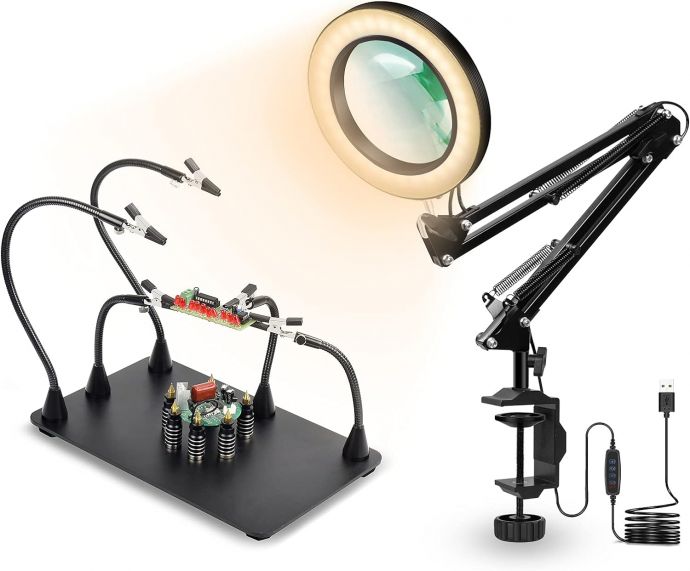
- **Articulating arm (for easy positioning above your work)**
## Step-by-Step Assembly Guide
### Step 1: Planning, Measuring & Cutting the Case
Decide on the footprint and shape, then measure your fan and filter dimensions accordingly. For a desktop unit:
- Front opening: ideally 6" x 6" (about 15 x 15cm), matching your filter size.
- Internal shelf or bracket to hold filter snug against intake.
- Slot for fan, ensuring airtight fit.
- Access panel for filter swaps.
If working with 3D prints, several open-source designs are available online (search “solder fume extractor STL”). For a box build, sketch out panel cutouts, mark, and cut with a Dremel or drill.
### Step 2: Mounting the Fan
Orient the blower so that it pulls air in from the filter and exhausts it out the back/side. Use vibration dampening mounts (rubber grommets or soft foam tape) to reduce noise.
Wire the fan to your planned power supply, routing connections through a power switch and, optionally, a fan speed controller.
### Step 3: Installing Filters
- Place the HEPA filter directly behind the intake grille.
- Cut the activated carbon pad to match and layer it behind the HEPA.
- Use foam gasket tape or rubber weatherstripping to seal filter edges—air should be forced through, not around, the filter media.
- Secure with clips, a bracket, or a spring-loaded system for easy removal.
### Step 4: Assembly and Finishing Touches
- Close up the case and secure all panels.
- Add non-slip feet or mount to a weighted base for safety.
- Affix an adjustable arm if you want overhead or angled positioning. Even a gooseneck lamp mount can be repurposed.
- Attach a grill or mesh over the intake to prevent direct filter damage and to catch large debris.
### Step 5: Wiring and Powering Up
- Solder the power and control connections as planned.
- Test your fan at varying speeds to ensure strong suction.
Add an LED indicator to show power status, and test your noise levels with a smartphone app if desired.
## How to Use Your DIY Fume Extractor
Place the intake as close as possible to your soldering workpoint—ideally 1-3 inches away. The goal is to catch rising smoke before it diffuses into the room. For surface-mount or detailed work, an overhead mounting option really shines.
Regularly check and replace your filters. A noticeable drop in suction, visible discoloration, or persistent odors are clues that it’s time for a refresh. With high use, expect to swap carbon filters every few months and HEPA filters a couple of times a year.
## Enhancing Performance: Pro Tips and Upgrades
- **Ducted Extraction:** For ultimate fume removal, add a flexible duct to the blower’s output and vent outside through a window or wall port—especially if working with leaded solders or for hours at a time.
- **Filter Layering:** Some users have success with a pre-filter (fine synthetic pad) to catch larger dust and extend the life of the HEPA/carbon pack.
- **Noise Reduction:** Line the enclosure with acoustic foam if you find the fan noise intrusive.
- **Smart Controls:** Add an Arduino or ESP microcontroller to automate fan speed based on workspace air quality sensors or enable remote control.
## Cost Savings and Environmental Impact
A commercial fume extractor with similar performance might set you back $100–$300 or more. DIYing your system often comes at a third or less of the price, especially if you can salvage some parts or 3D print components. Building your own also means you can replace just filter media rather than whole units, reducing waste and ongoing costs.
## Safety Reminders
- **Never solder in a closed, unventilated space—even with a fume extractor, extra ventilation helps.**
- **Dispose of used filter media responsibly—some contaminants may be hazardous.**
- **If you notice persistent irritation, consider upgrading filter quality or supplementing with additional ventilation.**
## Real-World Results
Users report that a well-built 12V DIY fume extractor rivals or outperforms many consumer models. The HEPA-and-carbon approach eliminates the characteristic “flux” haze and odor. In side-by-side comparisons, the difference in air clarity and comfort near the workstation is dramatic.
Moreover, the satisfaction of building your own essential bench tool—customized to your particular needs and style—is a bonus that extends beyond technical specs. You’re not just soldering circuits; you’re engineering your workspace for health and performance.
## Final Thoughts: Invest in Your Lungs—and Productivity
Soldering fumes are an invisible risk, but with a weekend’s work and modest investment, you can turn your station into a cleaner, safer, and more professional environment. Your DIY 12V solder smoke savior doesn’t just protect your lungs—it makes soldering more pleasant, less distracting, and even boosts your finished results by keeping your workspace clear.
Whether you’re a maker, repair tech, or electronics artist, this project is one of the most worthwhile upgrades you can make. Not only will you be safer, but you’ll work with the peace of mind that comes from knowing you’ve engineered your station for both health and high performance. Now, you can truly breathe easy—and solder on.