Soldering and jewelry crafting share a common challenge: keeping tiny parts steady while your hands do the rest. Even when you’re highly skilled, the “second problem” always shows up—working space, unstable components, and the constant repositioning of clamps. That’s where precision tools make all the difference. A dual-head magnetic third hand is one of those upgrades that quietly transforms your workflow, turning fiddly, frustrating sessions into confident, repeatable results.
This kind of tool isn’t just about holding things in place. It’s about creating a controlled environment for detail work: consistent angles, stable positioning, clean access to the joint, and hands-free stability that lets you focus on the real task—forming strong connections and beautiful pieces. If you’ve ever fought a sliding component, chased solder across a gap, or tried to hold a delicate wire while cutting, filing, or polishing, you’ll recognize the value immediately.
## Why “holding” is the hardest part of precision work
In theory, soldering and jewelry making look straightforward: position the parts, apply heat, add solder (or join components), and let everything cool. In practice, precision work depends on factors that are hard to control if parts aren’t held perfectly:
- **Heat management and alignment:** If the joint shifts even slightly while flux heats up or solder wicks, you can end up with misalignment, weak adhesion, or a visible seam.
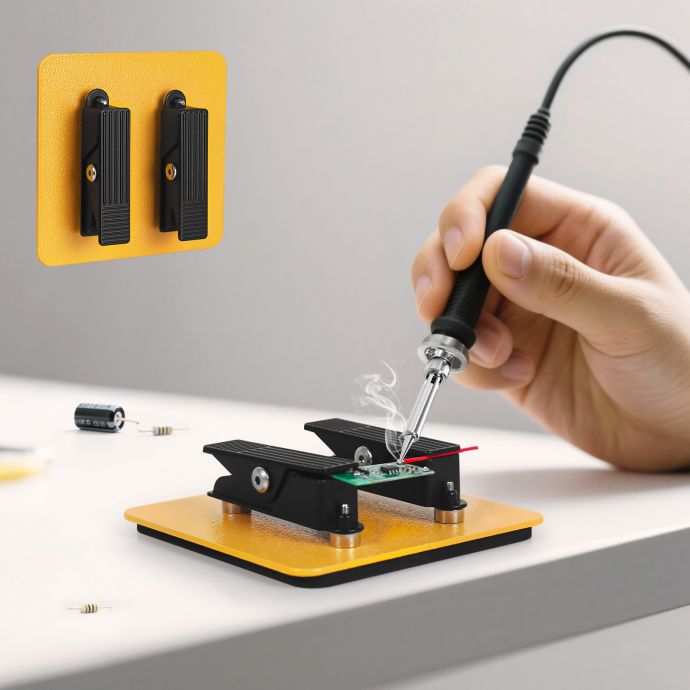
- **Micro-movements:** Tweezers and small soldering tools have fine control, but they still introduce subtle movements when you’re trying to hold multiple pieces at once.
- **Access matters:** Your soldering iron or torch needs an unobstructed path to the joint. Poor positioning forces you to work around clamps, which increases the chance of smearing flux or overheating nearby areas.
- **Repositioning interrupts rhythm:** Constantly adjusting a third-hand setup costs time and breaks your focus—especially when you’re working with tiny parts that cool quickly.
A well-designed holding tool solves these problems by making stability automatic rather than something you continually manage.
## Introducing the dual-head magnetic advantage
A dual-head magnetic third hand takes the core concept of a traditional third hand—an articulated stand with clamps—but upgrades it with a magnetic approach and an extra set of positioning options.
Instead of relying on a single holding point, you get **two independent “heads”** (often clamp-like or pick-and-place style holders) that can be positioned to support different parts at the same time. Add magnets into the equation and the result is typically a tool that is:
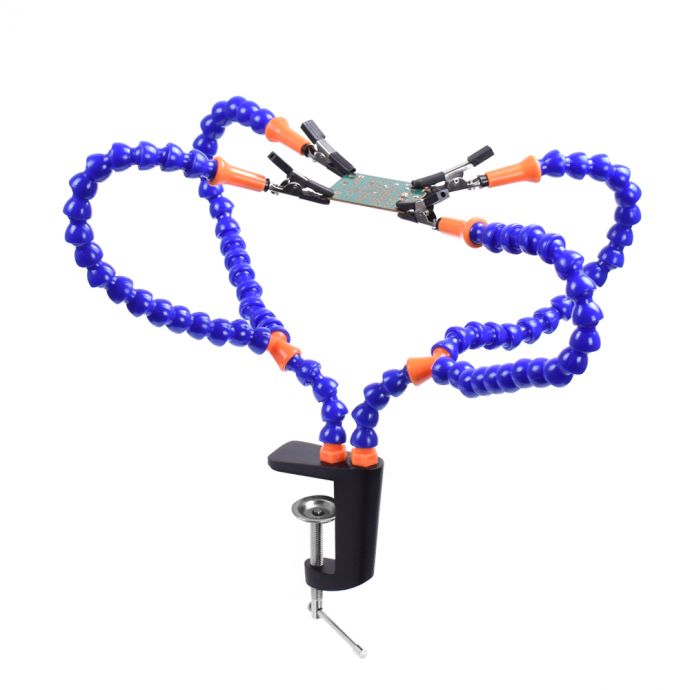
- **Faster to position** (magnetic placement reduces fiddling)
- **More versatile** across irregular shapes and different joint types
- **More stable** because the workpiece can be held from multiple angles
- **Easier to reconfigure** as you move from soldering to assembly or finishing steps
The dual-head setup makes it easier to hold the component you’re actively heating while simultaneously stabilizing a second part—such as wire ends, jump rings, small connectors, or a delicate frame.
## Transforming soldering: stability that improves results
Soldering success isn’t only about technique; it’s also about preparation and control. A dual-head magnetic third hand helps on multiple levels.
### 1) Better alignment at the critical moment
When you apply heat and solder starts to flow, the joint has to remain exactly where you intended. With a dual-head holder, you can support one piece so it can’t twist, while the second head stabilizes the mating component at the proper gap. That matters for:
- **Wire-to-wire joints**
- **Tabs and small brackets**
- **Thin sheet metal seams**
- **Repairs where the fit is snug but not perfect**
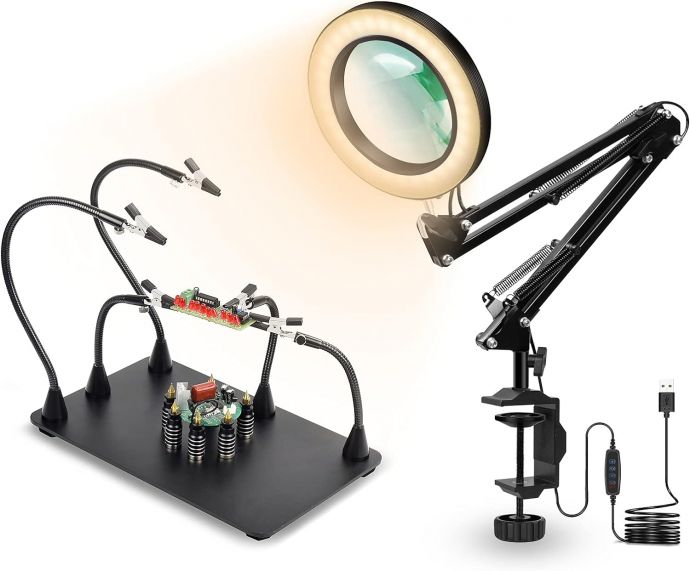
Even a tiny shift can create a gap that solder doesn’t bridge cleanly. By keeping parts aligned, you get cleaner joints and fewer rework cycles.
### 2) Cleaner solder flow and fewer “hot spots”
When parts wobble, heat distribution becomes inconsistent. A stable setup encourages more predictable heating so solder wicks where it should. You spend less time chasing the joint and more time guiding solder deliberately.
Additionally, a reliable hold reduces the time your iron is in contact with the work. Shorter heating cycles help protect nearby components—especially important in jewelry where different elements may react differently to heat.
### 3) More accessible work angles
Third-hand stands often limit how you can angle your work. With two heads, you can adjust the configuration to suit the joint rather than forcing the joint to fit the tool. For example:
- Hold a wire so the solder seam faces upward for easy capillary action.
- Position the second head so your iron has a clear approach without brushing clamps.
- Flip or rotate the work with reduced risk of parts shifting.
This flexibility is a major quality-of-life upgrade, especially when you’re working on multiple sides of the same piece.
### 4) Reduced stress on your hands
The best soldering sessions feel calm. Instead of gripping parts with tweezers for dear life, you can hold your tools with a relaxed, steady posture. A magnetic dual-head third hand effectively gives you “extra hands” that don’t fatigue or drift.
That means more consistent pressure when applying flux, more accurate placement of pre-cut solder, and safer handling when your workpiece is tiny or hot.
## Elevating jewelry crafting: precision for the smallest components
Jewelry crafting often involves steps that are just as delicate as soldering itself: aligning components, holding tiny parts while you attach them, and preparing surfaces for finishing. The dual-head magnetic third hand supports these tasks in ways that help you maintain craftsmanship standards.
### 1) Working with small hardware becomes easier
Jewelry components such as jump rings, chain links, clasps, bails, and tiny connectors are notoriously difficult to position. A magnetic third hand can hold one piece firmly while you maneuver another into place with a second set of hands—without constantly repositioning or using excessive tweezers.
The dual-head design is especially helpful when you need to:
- **Hold a chain or wire while attaching a clasp**
- **Center a component on a base**
- **Stabilize a small assembly while you solder or glue**
### 2) More control during assembly and repairs
Repairs often require careful reassembly: aligning a broken seam, matching the original position of a hinge, or correcting a crooked connection. A dual-head third hand makes it easier to “stage” the piece before applying heat or adhesive.
Think of it like this: instead of trying to build alignment while everything is loose, you can hold the components in the correct relationship first—then perform the bonding step confidently.
### 3) Less frustration with irregular shapes
Traditional clamps can be awkward for irregular or rounded items. Magnets offer an alternative holding method that can be more intuitive for certain materials and forms. When magnets are designed to interact effectively with common metal types or provide stable contact points, you gain a holding method that adapts to the work rather than forcing the work to conform to a clamp jaw.
This matters for:
- Curved frames
- Rolled wire sections
- Small pendant bails and odd angles
- Parts with limited flat surfaces
### 4) Better workflow from soldering to polishing
Soldering is rarely the last step. After joining, you usually need to clean, file, and polish. With a stable setup, you can reduce damage while transitioning between steps. The piece stays secure long enough for you to:
- Rinse and inspect joints
- Remove flux residue carefully
- File or sand a seam evenly
- Prepare surfaces for final polishing
Your work becomes more consistent because you aren’t improvising a holding method every time you change tasks.
## How a magnetic third hand improves consistency and repeatability
One of the biggest benefits of upgrading a tool isn’t just comfort—it’s consistency. When you can position parts accurately and repeatably, your output becomes more predictable. Over time, that means:
- Cleaner solder joints with fewer visible gaps
- More uniform alignment on paired components
- Reduced likelihood of overheating adjacent sections
- Faster sessions because you spend less time “re-fighting” the setup
A dual-head system supports repeatability in two ways: **stable initial placement** and **reliable hold during bonding**. That’s the difference between a piece that looks good occasionally and pieces that look good often.
## Practical scenarios where it shines
To understand the impact, it helps to imagine real projects. Here are a few common scenarios where a dual-head magnetic third hand tends to pay off quickly:
1. **Wire frame soldering**
Use one head to hold a wire segment at the corner while the other head stabilizes the perpendicular segment. This supports tight alignment and clean corner seams.
2. **Earring component assembly**
Hold tiny connectors or jump rings while positioning bezels or findings. The second head helps keep small pieces from spinning or sliding when you bring the iron or solder near.
3. **Repairs and rework**
When a repaired joint must match the original alignment, dual heads let you stage the corrected position before heating. Reduced movement at the joint leads to fewer compromises.
4. **Miniature chain and connector work**
Chains are flexible and difficult to keep from tangling or shifting. A stable dual-point setup helps prevent unwanted movement while you attach or solder connectors.
5. **Small hardware fabrication**
For brackets, small tabs, and micro-fittings, holding from two sides reduces twisting and ensures the joint stays where your measurements intended.
## Choosing the right setup for your needs
Not all third-hand tools are created equal. When selecting a dual-head magnetic third hand, consider features that affect performance:
- **Head adjustability:** The more accurately you can position each head, the more angles you can work from.
- **Magnet strength and compatibility:** Ensure the magnetic system works well with the materials you typically use (and that it provides stable contact without interfering with your project).
- **Clamp material and tips